


Lithium-ion Battery Selection Guide for Power Tools
Cordless power tools such as drills, impact screwdrivers, angle grinders, and gardening equipment rely on high-performance lithium-ion battery packs for proper operation.
Selecting an unsuitable battery may result in reduced power output, excessive heat generation, shortened service life, or potential safety risks.
This guide provides a reference for selecting lithium-ion batteries for power tools. It is intended for product engineers, manufacturers, OEM/ODM buyers, and end users evaluating battery specifications.
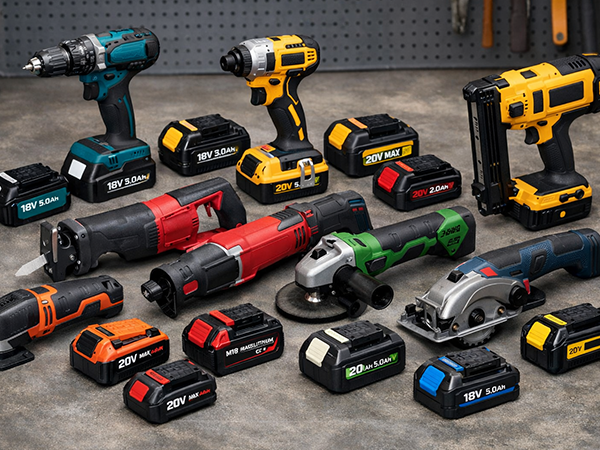
1. Common Lithium Battery Voltage Platforms for Power Tools
Most power tool battery packs are built using 18650 or 21700 lithium-ion cells, connected in series and parallel to achieve the required voltage and capacity.
Market Voltage Name | Battery Structure | Nominal Voltage | Typical Tools |
12V Max | 3S | 10.8V | Compact drills, screwdrivers |
14.4V | 4S | 14.4V | Legacy platforms |
**18V / 20V Max** | **5S** | **18.0V** | Drills, impact tools, grinders |
36V | 10S | 36.0V | High-power grinders, garden tools |
40V / 60V Max | 10s / 15s | 36–54V | Lawn mowers, chainsaws |
“20V Max” refers to the maximum charging voltage, not the nominal operating voltage. The actual working voltage of a 5S lithium-ion battery is approximately 18V.
The 18V (5S) platform remains the most widely adopted standard in professional power tools worldwide.
2. Capacity Selection by Tool Type
2.1 Electric drill and screwdriver
Parameter | Typical Range |
Voltage | 12V / 18V |
Capacity | **1.5Ah – 4.0Ah** |
Cell Type | 18650 or 21700 |
Key Focus | Lightweight & balance |
Typical Configurations
Household / DIY tools: 12V 2.0Ah
Professional drills: 18V 2.0–3.0Ah
2.2 Impact screwdrivers and wrenches
Parameter | Typical Range |
Voltage | 18V |
Capacity | **3.0Ah – 6.0Ah** |
Discharge Current | 30–60A |
Requirement | High-rate cells + smart BMS |
Technical Note:
Factory testing shows that torque loss is more often caused by insufficient discharge capability rather than insufficient capacity (Ah). A battery with adequate capacity but limited discharge performance may fail to deliver stable torque under load.
Parameter | Typical Range |
Voltage | 18V / 36V |
Capacity | **4.0Ah – 9.0Ah** |
Peak Current | 60–100A |
Preferred Cells | High-rate 21700 |
Design considerations for grinder battery packs typically include:
Reinforced current paths
Thermal dissipation optimization
High-current BMS design
2.4 Garden and Industrial Power Tools
Parameter | Typical Range |
Voltage | 36V–60V |
Capacity | **5.0Ah – 12Ah** |
Structure | Multi-series & multi-parallel |
Focus | Runtime, durability, thermal control |
3. Key factors other than voltage and capacity
3.1 Discharge Capability vs. Capacity (Ah)
Capacity alone does not determine tool performance. Batteries with high capacity but low discharge rates may experience voltage sag under high load conditions.
Factory Test Example
18V 5.0Ah (low discharge rate): noticeable voltage drop
18V 4.0Ah (high discharge rate): stable output
This highlights the importance of cell discharge characteristics in high-power tools.
3.2 Battery Management System (BMS)
A standard power tool BMS typically includes:
Overcharge protection
Over-discharge protection
Overcurrent protection
Short-circuit protection
Temperature monitoring
For OEM projects, BMS logic and communication protocols can be customized according to system requirements.
3.3 Cell Quality and Consistency
To ensure stable performance and cycle life, lithium battery packs typically undergo:
Incoming material inspection
Capacity grading
Internal resistance matching
Aging and reliability testing
These processes help improve:
Cycle life consistency
Operational safety
Batch-to-batch stability
4. Typical Power Tool Battery Configurations
Tool Category | Voltage | Capacity |
Compact drill | 12V | 2.0Ah |
Professional drill | 18V | 2.0–4.0Ah |
Impact wrench | 18V | 4.0–5.0 Ah |
Angle grinder | 18V / 36V | 5.0–8.0Ah |
Garden tools | 36V+ | 6.0–12Ah |
From a factory's perspective, professional buyers should always confirm the following:
1️⃣ Electrical Parameters
✔ Nominal voltage (S configuration)
✔ Rated capacity (Ah)
✔ Maximum continuous & peak current
✔ Charging voltage & current
2️⃣ Cell & Pack Design
✔ Cell brand & model
✔ Cell configuration (S × P)
✔ Cell fixing method (holders / adhesive / laser welding)
✔ Thermal management design
3️⃣ BMS & Safety
✔ BMS current rating
✔ Temperature protection points
✔ Communication protocol (if required)
✔ Balancing function
4️⃣ Certifications & Compliance
✔ UN38.3
✔ MSDS
✔ IEC / UL (if required by market)
✔ Factory quality system (ISO9001 / ISO14001)
5️⃣ Customization Capability (Very Important)
✔ Housing design
✔ Connector type
✔ Label & branding
✔ Firmware logic
✔ Charge compatibility
6️⃣ Manufacturing & Quality Control
✔ Incoming cell inspection
✔ Aging & capacity testing
✔ Load testing
✔ Traceability system
Selecting a lithium battery for power tools requires evaluation beyond nominal voltage and capacity. Discharge performance, cell quality, thermal design, BMS architecture, and manufacturing control all directly influence safety, lifespan, and output stability.
Battery reliability is determined by the combined effect of:
Cell quality
Discharge system design
Battery management strategy
Manufacturing consistency
About the Manufacturer
Shenzhen First Power Energy Co., Ltd. provides lithium battery solutions for global customers, focusing on power tool applications that require stable performance, safety compliance, and long-term reliability.





 E-mail


 +86 13510702894