


Li-ion vs. LiPo: Which Battery is Best for Your Product Line?
As the world needs more portable power, picking the right battery type is important for every manufacturer. When designing electric bikes, drones, robots, or smart devices, you need to choose the right battery.
The two main types are lithium-ion (Li-ion) batteries and lithium-polymer (LiPo) batteries. This choice is important for your design. This choice can affect your product's success.
Both technologies are common in today’s electronics. They provide different benefits in performance, safety, cost, and design flexibility.
In this article, we look at the main differences, benefits, and uses of Li-ion and LiPo batteries. This will help you decide which type is best for your products.
1. What Are Li-ion and LiPo Batteries?
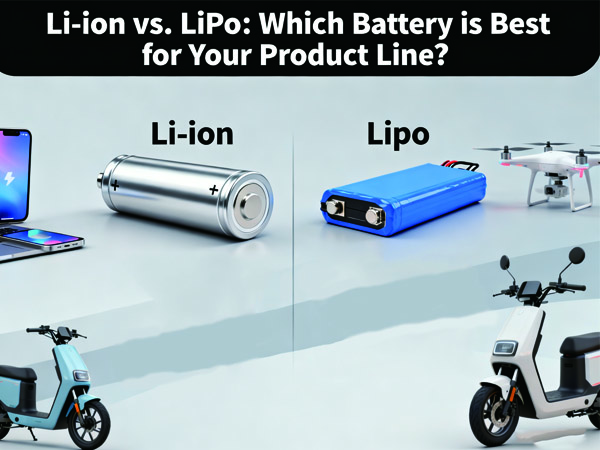
Li-ion batteries are rechargeable cells that use liquid electrolytes to transport ions between the anode and cathode. People commonly use them in laptops, electric vehicles, and power tools because of their high energy density.
LiPo batteries are a type of lithium battery. They use a solid or gel-like polymer electrolyte instead of a liquid. This makes them lighter and more flexible in shape, popular among drones, RC models, and slim consumer devices.
2. Structure and Composition Differences
- Li-ion: Cylindrical or prismatic cells, sealed with a liquid electrolyte.
- LiPo: Soft pouch cells using polymer electrolytes, allowing custom-shaped designs.
Li-ion batteries usually provide better protection from physical damage because of their hard casing. In contrast, manufacturers design LiPo batteries to be smaller and customizable, making them great for devices with limited space.
3. Energy Density and Performance
Energy density determines how much energy a battery can store relative to its size or weight.
Li-ion batteries usually have a higher energy density of 150 to 250 Wh/kg. This makes them good for uses that need a long runtime.
LiPo batteries have a lower density of 100 to 180 Wh/kg. However, they provide better discharge rates. This makes them great for high-power bursts in drones or RC cars.
In short, Li-ion = more energy; LiPo = more power flexibility.
4. Safety and Stability
Both types can be safe if made and used correctly. However, Li-ion batteries can overheat more easily. This happens if someone damages them or charges them incorrectly because of their liquid electrolytes.
LiPo batteries, while less likely to leak, can still swell or puff if overcharged or physically stressed. Advanced Battery Management Systems (BMS) are therefore essential to ensure long-term safety in both chemistries.
Shenzhen First Power Energy Co., Ltd. The company uses strict testing methods. These include high-temperature aging, vibration, and short-circuit tests. This ensures that both Li-ion and LiPo batteries meet CE, UL, and EN50604 standards.
5. Lifespan and Cycle Performance
Li-ion batteries usually last between 500–1000 full charge cycles, maintaining over 80% capacity after hundreds of uses.
LiPo batteries usually provide fewer cycles, around 300 to 600. However, they work better in situations needing quick energy bursts.
6. Weight and Form Factor
Weight and design flexibility are major factors for modern electronics.
Li-ion cells are heavier and usually cylindrical, like 18650 or 21700. In contrast, LiPo cells can be exceptionally thin or shaped to fit curved or small spaces. This makes them perfect for drones, wearables, and slim industrial devices.
7. Cost Considerations
Li-ion batteries benefit from mature manufacturing technology, offering lower costs per Wh of energy.
LiPo batteries may cost a bit more, but they are worth it. They are great for designs that need to be small, flexible, and powerful.
8. Charging Characteristics
Li-ion batteries charge well and keep a stable voltage over a wide range. This makes them great for steady power delivery.
LiPo batteries can charge faster but require precise voltage balancing to avoid damage. Shenzhen First Power’s advanced BMS systems ensure optimal charging control for both chemistries, preventing overcharging or thermal stress.
9. Environmental Impact and Recyclability
Special facilities can recycle both Li-ion and LiPo batteries. Ongoing efforts aim to recover lithium, cobalt, and nickel. Shenzhen First Power Energy Co., Ltd. supports sustainable manufacturing by utilizing eco-friendly materials, low-emission equipment, and battery recycling systems to minimize environmental impact.
10. Which Battery Is Better for Your Application?
- For **E-bikes, AGVs, and industrial tools**: Li-ion batteries are great because they have high energy density and last a long time.
For **drones, robotics, and consumer gadgets**, manufacturers prefer LiPo batteries because of their lightweight design and high discharge capabilities.
- For **portable medical and IoT devices**: Both can work, depending on power requirements and form factor constraints.
11. Shenzhen First Power’s Expertise in Battery Customization
As a professional lithium battery manufacturer with more than 12 years of experience, Shenzhen First Power Energy Co., Ltd. offers tailored solutions for both Li-ion and LiPo battery systems. The company focuses on cell selection, pack design, and BMS integration. They ensure a good balance of energy, power, safety, and cost.
Its automated production lines, advanced laser welding, and real-time quality monitoring guarantee high consistency and reliability. Every battery pack undergoes rigorous testing, including capacity, cycle, vibration, and waterproof validation (IP67 level).
12. The Future: Hybrid and Next-Gen Lithium Batteries
Innovation in battery technology continues to evolve. First Power’s R&D team is working on hybrid solutions. These solutions combine the energy density of Li-ion batteries with the flexibility of LiPo structures.
Researchers study new materials like solid-state electrolytes and graphene-enhanced cathodes. They aim for longer life, faster charging, and better safety.
Conclusion: Choosing the Right Battery Partner
The choice between Li-ion and LiPo batteries depends on your product's power needs, space limits, and target market.
Shenzhen First Power Energy Co., Ltd. We provide both types of advanced lithium batteries. We also offer expert advice to help clients choose the best solution.
First Power combines technology, precision engineering, and sustainability. This way, every battery pack, whether Li-ion or LiPo, powers your products safely and efficiently for the future.
About Shenzhen First Power Energy Co., Ltd.
Shenzhen First Power Energy Co., Ltd. is a top lithium battery maker. They focus on Li-ion and LiFePO4 battery packs. Their products are for e-bikes, AGVs, robotics, solar systems, and custom uses. Founded in 2012, the company provides full OEM/ODM services, advanced BMS integration, and international certifications (CE, UL, EN50604).

 E-mail


 +86 13510702894