


Electric Bicycle Battery Regulation in Europe:What Manufacturers Must Know
As the global transition toward low-carbon transportation accelerates,Europe has emerged as the fastest-growing market for electric bicycles(e-bikes).However,this market opportunity comes with unprecedented legal challenges.The New EU Battery Regulation(EU)2023/1542,which officially entered into force in 2023 and is being phased in from 2024 onwards,has fundamentally redefined the rules for the design,production,sale,and recycling of e-bike batteries.
For e-bike battery manufacturers,brands,and exporters,understanding this regulation—often cited as the world's most stringent battery law—is no longer optional;it is the"passport"to the European market.This article provides an in-depth analysis of the core requirements to help businesses identify critical milestones and ensure operational continuity.
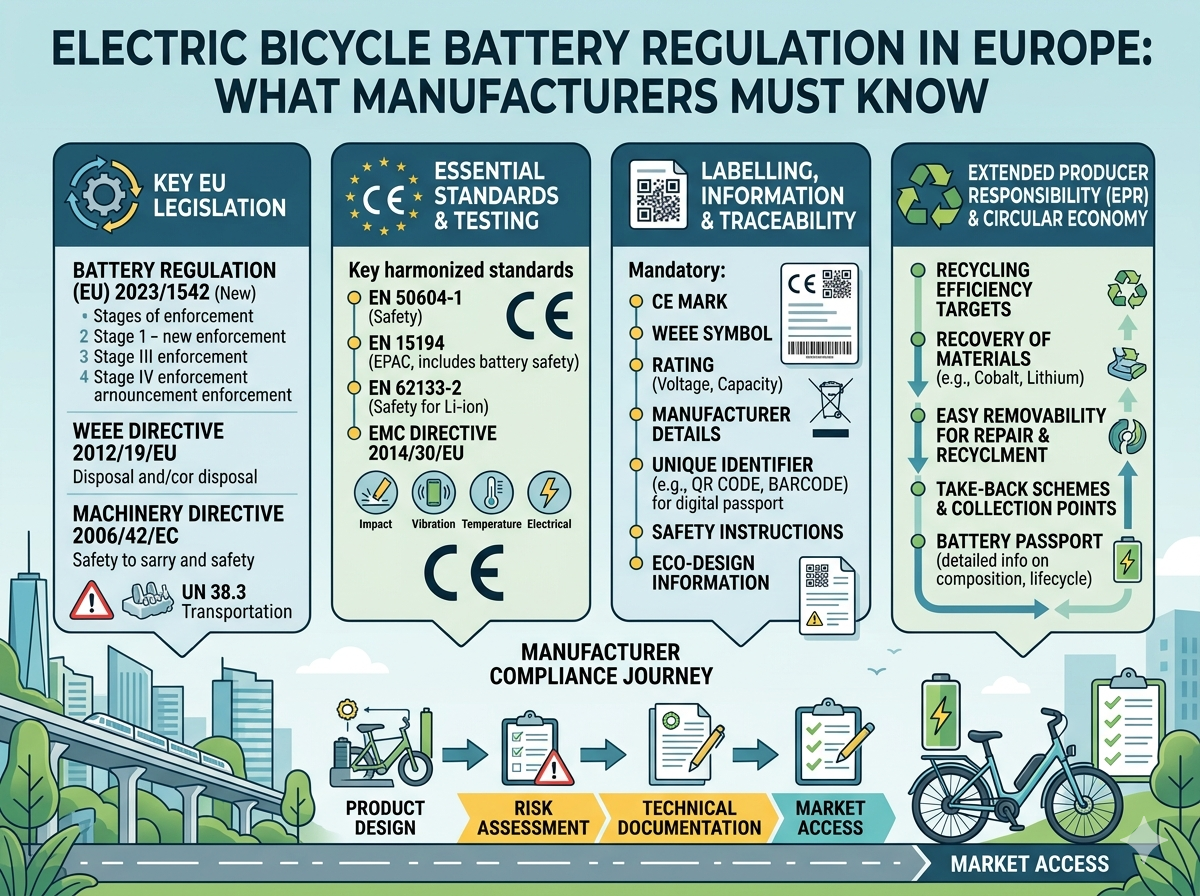
1.Core Classification:The Definition and Status of LMT Batteries
Under the old EU Directive(2006/66/EC),the classification of e-bike batteries was often ambiguous.The new regulation explicitly introduces a dedicated category:Light Means of Transport(LMT)Batteries.
What are LMT Batteries?
According to(EU)2023/1542,an LMT battery is defined as:
Sealed.
Weighing 5kg or less.
Specifically designed to provide traction to wheeled vehicles such as e-bikes,e-scooters,and similar light transport tools.
Manufacturer’s Note:If your battery falls into this category,you must comply with significantly stricter performance,safety,and sustainability requirements compared to standard"portable batteries."
2.Four Pillars of Compliance for Manufacturers
The new regulation shifts focus from mere safety to the entire lifecycle sustainability of the battery.Here are the four critical dimensions:
2.1 Carbon Footprint Declaration
Starting in 2025,LMT batteries entering the EU market must be accompanied by a Carbon Footprint Declaration.
Phase 1:Disclosure of the total carbon emissions generated during manufacturing.
Phase 2:Establishment of carbon emission performance classes.
Phase 3:Setting maximum carbon threshold limits(batteries exceeding this limit will be prohibited from sale).
2.2 Digital Battery Passport
This is the most innovative part of the regulation.From February 2027,every LMT battery must possess a"Digital Battery Passport"accessible via a QR code.
Content:Information on the battery model,chemical composition,manufacturing origin,recycled content,and performance indicators(State of Health/Capacity).
Transparency:Designed to provide end-users,repairers,and recyclers with vital data to facilitate a circular economy.
2.3 Removability and Replaceability
The regulation mandates the enhancement of the"Right to Repair."
Professional Replacement:Unlike mobile phones,LMT batteries must be designed so that they can be easily removed and replaced by independent professionals using commonly available tools.
Spare Parts Availability:Manufacturers must ensure that spare parts are available to independent repairers for a specific period(usually 5 to 10 years).
2.4 Recycled Content Requirements
To drive a circular economy,the EU mandates that batteries contain a minimum percentage of recovered materials.
2031 Targets:Cobalt(16%),Lead(85%),Lithium(6%),and Nickel(6%).
2036 Targets:These percentages will significantly increase in the second phase.
3.Compliance Timeline:The Countdown for Manufacturers
The regulation is implemented in stages.Knowing these dates is crucial for supply chain planning:
Date | Requirement | Target Audience |
August 18,2024 | Mandatory CE Marking and conformity assessment | All batteries |
February 18,2025 | Strict thresholds for hazardous substances(Lead,Mercury,Cadmium) | All batteries |
August 18,2025 | EPR(Extended Producer Responsibility)obligations take effect | Manufacturers/Importers |
2026 | Labeling and performance durability requirements | LMT Batteries |
February 18,2027 | Mandatory Battery Passport and QR Code | LMT/EV Batteries |
February 18,2027 | Mandatory design for battery replaceability | LMT/Portable Batteries |
4.Extended Producer Responsibility(EPR)and Registration
If your company is the first to place a battery on the market in an EU member state,you are considered a"Producer."
What is EPR?
EPR requires producers to be responsible for the entire lifecycle of the product,especially the end-of-life recycling.
National Registration:You must register for EPR in every member state where you sell(e.g.,EAR in Germany,ADEME in France).
Recycling Quotas:The EU has set aggressive collection targets for LMT batteries(51%by 2028,reaching 61%by 2031).
Eco-Contributions:Producers pay fees to Producer Responsibility Organizations(PROs)based on the volume of batteries sold.
5.Frequently Asked Questions(FAQ)
Q1:Do older e-bike batteries need a Battery Passport retrospectively?
A1:Generally,the law is not retroactive.Only new batteries"placed on the market for the first time"after the specific deadlines must comply with the requirements.
Q2:Can I still sell batteries in Europe without a CE mark?
A2:No.Since August 2024,the CE mark is mandatory,indicating that the product has passed safety,durability,and compliance assessments.
Q3:How much will the new regulation increase costs?
A3:In the short term,compliance testing,data tracking,and EPR registration may increase costs by 5%to 15%.However,this will eventually filter out low-quality competitors and allow for premium branding.
Conclusion:Compliance as a Competitive Edge
The EU Battery Regulation(EU)2023/1542 is more than just a trade barrier;it is a signal of industry consolidation.For manufacturers who can quickly adapt to carbon footprint disclosures,implement closed-loop recycling,and embrace digital transparency,this regulation represents a unique opportunity to build a competitive advantage through technical excellence.
Action Plan:Manufacturers are advised to conduct a full audit of their product lines before the 2025 carbon footprint deadlines and establish robust partnerships with European certification bodies.



 E-mail


 +86 13510702894