


How Industrial Battery Design Impacts AGV Performance
Automated Guided Vehicles (AGVs) have become the backbone of modern smart factories, warehouses, and logistics centers. As industries move toward more automation, they want faster production and less need for workers. Experts expect AGVs to work longer hours, carry heavier loads, and respond more accurately. At the heart of every AGV system lies one critical component that directly determines performance, reliability, and operational cost: the industrial battery.
While motors, controllers, and navigation systems often attract significant attention, many people frequently underestimate battery design. In reality, industrial battery design has a profound impact on AGV performance, influencing runtime, charging efficiency, safety, system stability, and total cost of ownership.
At Shenzhen First Power Energy Co., Ltd. (FirstPower), we specialize in designing and manufacturing customized industrial lithium battery solutions for AGVs and intelligent logistics equipment. This article looks at how battery design affects AGV performance. It also discusses what system integrators and OEMs should think about when choosing or creating an AGV battery solution.
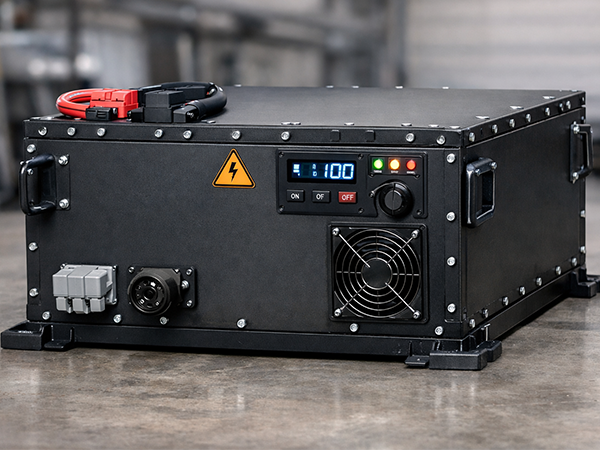
The Role of Industrial Batteries in AGV Systems
An AGV battery is not just an energy source. A core system component that interacts with:
Drive motors and motor controllers
Navigation and positioning systems
Safety sensors and communication modules
Fleet management software
Any problems with battery performance can affect the whole AGV system. This can lead to lower efficiency, unexpected downtime, or safety risks.
A well-designed industrial battery enables:
Stable power output under varying loads
Predictable runtime and charging cycles
Fast opportunity charging
Long service life
Safe operation in demanding environments
Key Battery Design Factors That Impact AGV Performance
1. Battery Chemistry Selection
Battery chemistry is the foundation of AGV performance.
Common Chemistries in AGVs
Lead-acid batteries
Lithium iron phosphate (LiFePO₄)
Ternary lithium (NMC/NCA)
LiFePO₄ batteries are now the top choice for modern AGVs. They offer a good balance of safety, long life, and thermal stability.
Impact on AGV Performance
Energy density affects vehicle weight and runtime
Discharge characteristics influence acceleration and climbing ability
Thermal stability determines safety in continuous operation
FirstPower focuses on industrial-grade lithium chemistries optimized for high cycle life and stable output, ensuring consistent AGV performance across long operating hours.
2. Voltage Platform and Power Matching
Why Voltage Matters
AGVs are typically designed around specific voltage platforms, such as:
24V
36V
48V
72V
The battery voltage directly impacts:
Motor efficiency
Current demand
Heat generation
System wiring requirements
Poor Voltage Matching Risks
Excessive current draw
Reduced motor efficiency
Increased heat and energy loss
Shortened component lifespan
At FirstPower, battery voltage platforms are custom-matched to AGV motor and controller specifications, ensuring optimal power delivery and system efficiency.
3. Discharge Rate and Load Handling
AGVs experience dynamic loads:
Acceleration and deceleration
Load lifting and lowering
Turning and climbing ramps
Importance of High-Rate Discharge Capability
A poorly designed battery may struggle to handle peak current demands, resulting in:
Voltage sag
Reduced driving force
System alarms or shutdowns
Industrial battery design must consider:
Cell discharge rating (C-rate)
Internal resistance
Parallel cell configuration
FirstPower makes AGV battery packs. These packs have low internal resistance and can handle high currents. This design ensures stable voltage output, even during peak loads.
4. Battery Management System (BMS) Design
The Brain of the Battery
The BMS is responsible for:
Voltage and current monitoring
Temperature protection
Cell balancing
Communication with AGV control systems
A basic BMS only provides protection, while an advanced BMS actively improves system performance.
How BMS Impacts AGV Operation
Prevents overcharging and over-discharging
Ensures consistent power output
Enables real-time battery status reporting
Supports predictive maintenance
FirstPower integrates smart BMS solutions supporting CAN, RS485, and other industrial communication protocols, allowing seamless integration with AGV fleet management systems.
5. Charging Strategy and Opportunity Charging
The Shift to Opportunity Charging
Modern AGV fleets now use opportunity charging. This means vehicles recharge for a short time when they are not in use. They do not need to stop for long charging sessions.
Battery design must support:
Fast charging capability
High cycle durability
Minimal degradation from partial charging
Battery Design Considerations
Cell chemistry optimized for frequent charging
Charger-battery communication
Thermal control during fast charging
FirstPower AGV batteries are designed to support fast and frequent charging, significantly improving fleet availability and warehouse throughput.
6. Thermal Management and Heat Dissipation
Heat as a Performance Limiter
Heat negatively impacts:
Battery efficiency
Cycle life
Safety
AGVs operating continuously in warehouses or factories can experience elevated temperatures, especially during high-current discharge or fast charging.
Thermal Design Elements
Cell spacing and airflow
Heat-conductive materials
Temperature sensors linked to BMS
Effective thermal management ensures stable performance and extends battery lifespan. FirstPower applies thermal simulation and real-world testing to validate battery designs for demanding AGV environments.
7. Mechanical Structure and Vibration Resistance
AGVs operate in environments with:
Floor vibrations
Sudden stops and starts
Load impacts
Poor mechanical battery design can lead to:
Loose connections
Weld fatigue
Internal cell damage
FirstPower industrial battery packs feature:
Reinforced internal structures
Shock-absorbing materials
Secure mounting solutions
Mechanical reliability directly contributes to long-term AGV performance stability.
8. Battery Size, Weight, and Space Optimization
Why Form Factor Matters
AGV designers often face tight space constraints. Battery dimensions and weight influence:
Vehicle balance
Payload capacity
Energy efficiency
An oversized or poorly shaped battery can compromise AGV maneuverability.
FirstPower provides custom battery enclosures tailored to AGV chassis designs, optimizing space utilization without sacrificing capacity or safety.
9. Environmental Adaptability
AGVs may operate in:
Cold storage warehouses
High-humidity environments
Dusty or partially outdoor facilities
Battery design must address:
Moisture protection
Low-temperature performance
Corrosion resistance
FirstPower offers AGV battery solutions with enhanced sealing, insulation, and environmental protection to ensure reliable operation under diverse conditions.
How Battery Design Impacts Total Cost of Ownership (TCO)
A well-designed AGV battery delivers value beyond performance:
Longer service life
Reduced maintenance requirements
Fewer unplanned shutdowns
Lower replacement frequency
While initial battery cost matters, TCO is determined by design quality and reliability.
FirstPower’s Approach to AGV Battery Design
At Shenzhen First Power Energy Co., Ltd., our AGV battery development process includes:
Application requirement analyzing
Electrical and mechanical system matching
Cell selection and grouping
BMS customization
Thermal and structural optimization
Performance and safety testing
This systematic approach ensures every battery solution supports maximum AGV efficiency and long-term reliability.
Real-World Impact: Better Battery Design, Better AGV Performance
AGV systems equipped with well-designed industrial batteries demonstrate:
Longer daily operating hours
Faster response and smoother motion
Improved fleet coordination
Reduced downtime and maintenance
Battery design is not an accessory. A performance multiplier exists.
Frequently Asked Questions (FAQ)
1. Why is lithium battery design critical for AGVs?
AGVs need stable power, quick charging, and a long battery life. These factors depend a lot on battery chemistry, BMS, and design.
2. What voltage is best for AGV batteries?
Common AGV voltages include 24V, 36V, and 48V. The best choice depends on motor power and system design.
3. How does BMS communication benefit AGV fleets?
It enables real-time monitoring, predictive maintenance, and integration with fleet management systems.
4. Can AGV batteries support opportunity charging?
Yes. Properly designed lithium AGV batteries are ideal for frequent and fast opportunity charging.
5. How long do AGV lithium batteries last?
Typically 2,000–5,000 cycles or 5–10 years, depending on usage and design quality.
Do customized AGV batteries perform better than standard ones?
Customized batteries provide better system matching, higher efficiency, and longer lifespan.
7. How does temperature affect AGV battery performance?
High temperatures accelerate aging, while low temperatures reduce capacity and output.
8. Can FirstPower provide OEM/ODM AGV battery solutions?
Yes. FirstPower specializes in OEM and ODM industrial battery solutions for AGVs and intelligent logistics equipment.
Conclusion
AGV performance is only as strong as the battery powering it. - Choosing the right chemistry and matching voltage are important for battery design.
- BMS intelligence and mechanical design also play a role.
- Each part of industrial battery design impacts AGV efficiency, safety, and cost.
By investing in well-engineered battery solutions, AGV manufacturers and operators can unlock higher productivity, longer system life, and lower operating costs.
Shenzhen First Power Energy Co., Ltd. We dedicate ourselves to creating advanced industrial battery designs. These designs help AGV systems work at their best now and in the future.
Related articles

-
2025-12-20
36V eBike Battery Buying Guide 2025...

 E-mail


 +86 13510702894